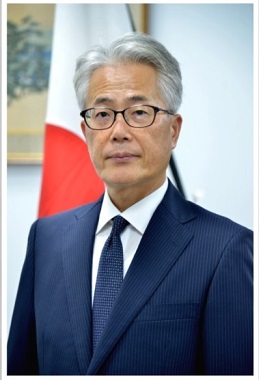
On the auspicious occasion of His Majesty the Emperor’s Birthday in the 3rd Year of Reiwa era (2021), I have the honour to extend my heartfelt congratulations to His Majesty, and would like to express my greetings to everyone.
In the year 2020, the unprecedented crisis of the COVID-19 pandemic brought on a tremendous impact all over the world, including Japan and India.
On January 1st this year, His Majesty the Emperor stated in a video message that we faced various difficulties and challenges in the previous year due to the spread of the coronavirus on such an unprecedented scale that most of us living in this era have never experienced before, and that many people lost their lives around the world and in Japan. His Majesty expressed his deep respect and gratitude to doctors, nurses, and those who are engaged in medical services, for devoting themselves day and night to save the lives of many patients. His Majesty also stated that, although humankind has been repeatedly hit by horrific plagues and major natural disasters in the past, we have overcome these challenges each time with unity and tenacity.
It is heart wrenching that many people have lost their lives because of COVID-19 in India. There were cases of Japanese people living in India being infected as well. I would like to express my deepest respect for the dedication and hard work of everyone, especially the health care workers, who are engaged in this fight to save lives from COVID-19 in India.
Looking back the Japan-India relations in the midst of the coronavirus pandemic, many employees of Japanese companies needed to go back to Japan, and I must say that our bilateral cooperation did suffer from various constrains. We, at the Embassy of Japan, have been ensuring the safety of Japanese nationals here as the top priority. At the same time, we have been steadily working to make strides in the bilateral relationship between Japan and India. For instance, we were able to achieve notable results including;
» the signing of Agreement Concerning Reciprocal Provision of Supplies and Services between the Self-Defense Forces of Japan and the Indian Armed Forces,
» the signing of Exchange of Notes concerning Yen Loan to India for the COVID-19 Crisis Response Support Loan for Social Protection,
» awarding of the contract of the biggest civil works package (C-4) of the Mumbai-Ahmedabad High Speed Rail (MAHSR) project and commencement of construction works,
» the signing of the first-ever comprehensive MoC in the Field of ICT between the two countries,
» the signing of MoC on a Basic Framework for Partnership for Proper Operation of the System pertaining to “Specified Skilled Worker”.
Furthermore, 2nd Japan-Australia-India-US Foreign Ministers’ Meeting was held face-to-face in Tokyo, which was followed by a multilateral naval exercise “Malabar 2020” joined by Japan Maritime Self-Defense Force, Royal Australian Navy, Indian Navy and the United States Navy.
All of these examples give a testament of the robust partnership between Japan and India, which have never ceased to move forward despite the unprecedented crisis we are in.
Next year, 2022, will mark the 70th anniversary of establishing the Japan-India diplomatic relations. In 1987, which was the hallway mark of the 70-year period, His Majesty the Emperor (then H.I.H. Prince Hironomiya) came to India and visited Delhi and other locations, such as Taj Mahal in Agra and Cave Temples in Ajanta. Over the years since then, the Japan-India relations have achieved dramatic and remarkable progress. The Japan-India partnership goes beyond the bilateral context, and encompasses all fields in the international community. And there still exists huge untapped potential for further development.
Although the COVID-19 situation still requires us to be cautious, I am determined to work with utmost efforts to strengthen the partnership between Japan and India, including the sphere of people-to-people exchange, and to elevate it to an even higher level.
In his message, His Majesty the Emperor shared his belief that the day when people could live with a firm hope for the future would surely come soon, and stated His Majesty’s sincere hopes that people would make strides forward by helping and supporting each other with compassion. With these thoughts in mind, I would like to forge ahead towards the further development of the Japan-India relations, along with the Japanese residents and all our friends in India.
23rd February 2021
SUZUKI Satoshi
Ambassador of Japan to India
◯ Photos of His Majesty’s visit to India in 1987

(Provided by THE YOMIURI SHIMBUN)
◯ Recent Portraits of Their Majesties the Emperor and Empress and Their Family on the occasion of the New Year
https://www.kunaicho.go.jp/e-okotoba/01/gokanso/r03-0101-mov.html
(Source:Recent Portraits of Their Majesties the Emperor and Empress and Their Family on the occasion of New Year (2021) (video) at the Imperial Household Agency website)
Ambassador's Message (01/2021)
Ambassador's Message (11/2019)
|